
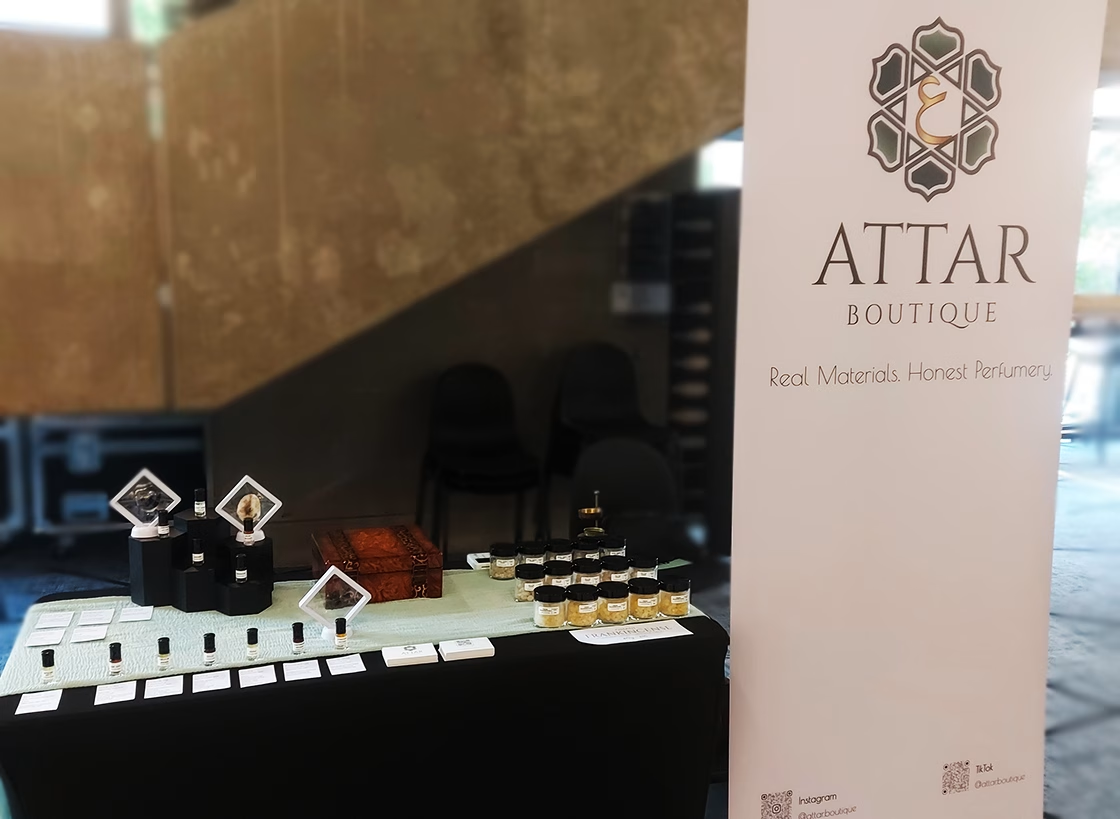
Alhamdulillah, it was a great tour. Rumi Revival was the first time I sold my attars face to face, and I’m grateful to everyone who came by my stall, bought an attar and asked me questions, especially the people who were smelling natural scents for the first time.
What People Said
The best part was seeing people’s faces light up at the first smell. Many told me the scents were unlike anything they’d tried before, and most were blown away at that first sniff and wanted to know more. I also loved hearing what the attars reminded people of: old mosques in Egypt, the smell of Lefke, the scent of Madina. Those aren’t notes you’d find on an ingredients list. They’re memories.
It was a pleasure to share what I know and my love of the craft with people, and their curiosity made it a wonderful experience.
Not Everyone Liked It
A few people didn’t like it, and one person pulled a face after smelling Mysore sandalwood oil. That’s fair. From what I saw, most people who hadn’t tried natural perfumery before were struck by it, and a few simply didn’t care for it.
How to Tell a Real Natural Attar From a Synthetic One
People being so struck by something they’d never smelled leads to an obvious question: what actually separates a natural attar from a synthetic one?
The most reliable way is a laboratory test, but that isn’t realistic for most people, so in practice it comes down to your nose. A fully natural attar smells deep, it evolves on the skin over time, and it can’t contain certain scents that only synthetic molecules can produce. What I make are blends of natural materials, which is why I call them mukhallats by the stricter definition even though most people know them as attars.
What a Natural Blend Smells Like
A fully natural blend smells deep, and it evolves on the skin over time rather than staying as it was when you first put it on. Natural materials are made up of many aromatic compounds, and a blend of them gives you something with real depth to it.
Scents Only Synthetics Can Produce
Some scents can’t be captured from the plant at all. Lily of the valley is the best-known example: neither steam distillation nor solvent extraction captures it, so lily of the valley notes in perfumery are built from synthetic molecules. Lilac is in the same position. The clean, marine freshness of aquatic fragrances comes from a synthetic molecule called Calone, and that family of scents didn’t exist in perfumery before it. So if an attar smells strongly of lily of the valley, lilac or ocean air, it most likely contains synthetics.
Iso E Super and Hedione
Two synthetic molecules in particular turn up in a large number of modern perfumes. Iso E Super was created in a laboratory at IFF in 1973 and doesn’t exist in nature. It has a velvety, cedarwood-like note that sits close to the skin. Hedione, the trade name for methyl dihydrojasmonate, was developed by Firmenich and made its name in Dior’s Eau Sauvage in 1966. It’s made by chemical synthesis rather than extracted from a natural source, and it’s known for a transparent, airy radiance. If a blend has that velvety woody haze, or an airy, luminous quality sitting over the florals, it’s worth asking whether either is in there.
Learning to Tell the Difference
With time and experience, a nose can learn to pick out a fully natural attar from a synthetic one. If you’ve never smelled natural perfumery, the Samples page is an easy place to start.
Ask What’s in It
Whatever your nose tells you, it’s reasonable to ask a maker plainly what’s in a blend. A maker who can answer that clearly is telling you something, and so is one who can’t.
