
Fragrance in the Hadith Tradition
There’s a hadith, narrated by Anas (radiAllah anhu) and recorded in Sunan an-Nasa’i, where The Blessed Prophet ﷺ said that three things had been made dear to him in this world — women, perfume, and prayer, with prayer described as the comfort of his eyes. What stands out to me is that of the three, scent is the only one that’s a physical object at all. Women are companions, prayer is an action, and perfume is a thing you can hold, apply, and smell. And yet it sits in that same list, which tells you it was never really about the object itself. A pleasant scent was understood to reach something beyond the senses.
That idea runs through other hadith too. The Prophet ﷺ compared a believer who recites the Qur’an and lives by it to a citron, pleasant in both taste and scent, while someone who lives rightly without reciting is like a date, sweet but without fragrance. The comparison isn’t really about fruit. It’s scent standing in for something about the state of a person’s heart, used because a good scent was already understood as a marker of something good underneath it.
Musk in particular is singled out. The Prophet ﷺ said it was the best of perfumes, and the Qur’an itself describes the drink of paradise as sealed with musk. Across the tradition, musk isn’t just one fragrance among many. It’s treated as a kind of benchmark, the standard against which good scent is measured, right up to how paradise itself is described.
Fragrance and the Soul
Ibn al-Qayyim (rahimahullah), the classical scholar, wrote specifically about this. He described pleasant fragrance as something that genuinely nourishes the soul, strengthening it the way food strengthens the body, and said it brings joy to the heart and lifts the self in a way few other things do. He went further, describing good scent as something angels are drawn to, while foul smells are something the reverse is drawn to. Scent isn’t decoration. It does something to the state a person is in.
It’s said in some circles that those who walk the Sufi path report sensing fragrance during moments of deep dhikr, a sign of something lifting rather than anything physical in the room.
Umm Sulaym and the Prophet’s ﷺ Sweat
There’s a well-known account, recorded in Sahih Muslim, involving Umm Sulaym, the mother of Anas ibn Malik (radiAllah anhuma). The Prophet ﷺ would rest at her house, and on one occasion she collected his sweat as he slept, gathering it into bottles. When he woke, startled, and asked what she was doing, she explained that she wanted it for its blessing, to mix into their perfume, since she believed it to be among the most fragrant things there was. He told her she’d done something right.
His own natural scent surpasses any perfume made by human hands. Anas said he never smelled anything more fragrant than the Prophet ﷺ himself, not amber, not musk, nothing crafted could compare to it. It’s widely reported that anyone who shook his hand would carry that scent on their own hand for the rest of the day, and that a child he’d touched could be picked out from among others by that same lingering fragrance. Even the streets of Medina carried it. People are said to have been able to tell which road He’d walked simply by the scent of musk still hanging in the air behind him.
The Story of Bishr al-Hafi
Before his turn toward Sufism, Bishr al-Hafi (rahimahullah) lived a life of dissipation, given to drinking and revelry. The traditional account tells of him staggering along a road one day, drunk, when he came across a piece of paper lying on the ground bearing the name of Allahﷻ. Rather than step over it, he stopped, picked it up, and took it home, where he perfumed it and placed it somewhere high and respected rather than leaving it to be trodden on again.
That night, he’s said to have had a dream in which he was told that because he had honoured Allah’sﷻ name by perfuming it, Allahﷻ would in turn perfume his own name, in this world and beyond it. It’s told as the moment that marked the beginning of his spiritual opening, the point at which the direction of his whole life changed.
Amir Khusro and Nizamuddin Auliya
There’s a story told about Amir Khusro (rahimahullah), the poet and devoted disciple of Nizamuddin Auliya (rahimahullah), that speaks to how closely scent could be tied to a person. During a period when the khanqah’s resources had run dry, a poor man came seeking help, and Nizamuddin Auliya, having nothing else to give, handed over his own worn sandals as charity. Travelling separately, Amir Khusro crossed paths with the same man, caught a scent, and immediately recognised it as his master’s. He traded everything he had, an entire caravan of wealth, for the sandals, and carried them home on his own head out of reverence. When Nizamuddin Auliya saw him arrive with them, he’s said to have remarked, gently, that Khusro had gotten them cheap.
It’s a story about devotion more than anything else, but scent is what carries it. Khusro didn’t recognise his teacher by sight or by name. He recognised him by smell alone, from a man he’d never met before, carrying something his master had merely worn.
Ya’qub عَلَيْهِ ٱلسَّلَامُ and the Scent of Yusuf’s عَلَيْهِ ٱلسَّلَامُ Robe
The Qur’an tells the story directly, in Surah Yusuf (alaihi salam). Years after losing his son, and after he had lost his sight from grief, Ya’qub (alaihi salam) was far from Egypt when the caravan set out carrying Yusuf’s (alaihi salam) shirt. Before it had even arrived, Ya’qub (alaihi salam) told those around him that he could sense Yusuf’s (alaihi salam) scent, adding that they might think him senile. They did doubt him. When the bearer of good news finally reached him and cast the shirt over his face, his sight returned, and he reminded them that he knew from Allah what they did not.
It’s one of the more striking uses of scent in the Qur’an: a father sensing his son across a vast distance by smell alone. Ya’qub’s own words point to the source of this knowledge, which he said came from Allah. Rumi (rahimahullah) returns to the story more than once in the Masnavi, including in Books 2 and 3. In Book 3 the man carrying the shirt does not smell it, while Ya’qub (alaihi salaam), a hundred leagues away, does. Rumi uses this as an image of what love perceives that mere proximity and learning do not.
The Fragrance from Imam Bukhari’s Grave
Imam Bukhari (rahimahullah), the compiler of the most trusted hadith collection in Islam, passed away and was buried in Samarkand. According to classical biographical works, including al-Dhahabi’s (rahimahullah) Siyar A’lam al-Nubala’, a fragrance more pleasant than musk was reported to have risen from his grave for several days after his burial, drawing people to the site to collect soil from around it, until eventually a wooden enclosure had to be built to protect the grave from being worn away entirely.
Fragrance at Sufi Shrines and Gatherings
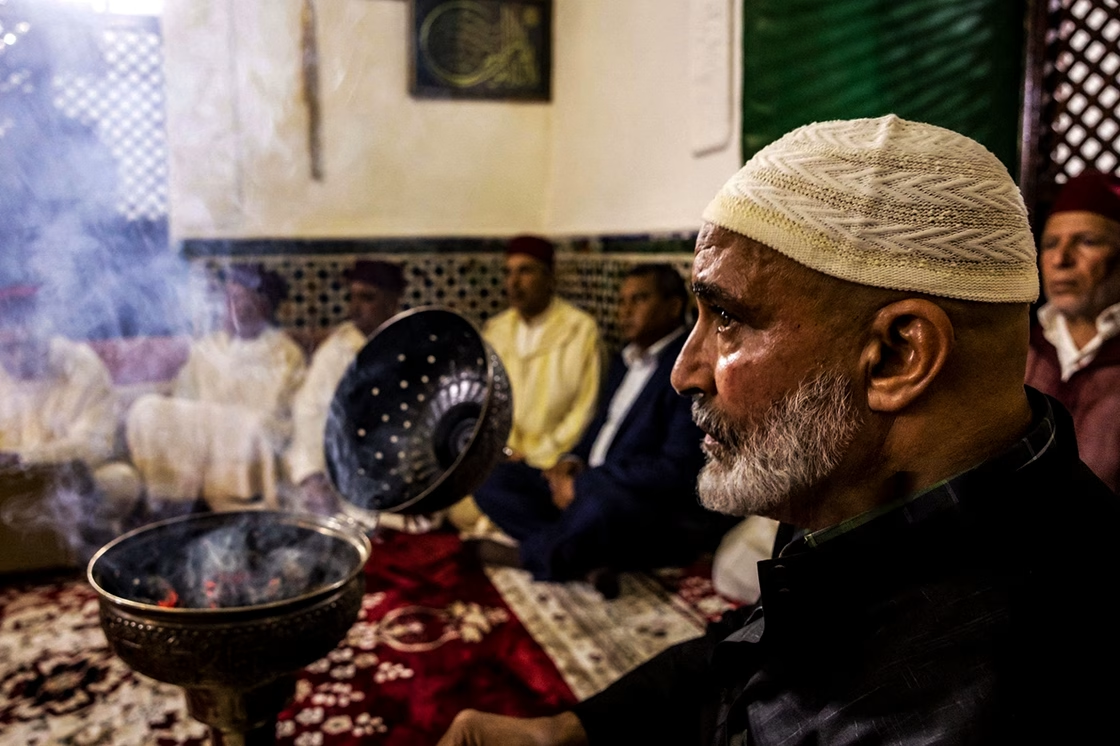
Scent has a real, practical place in Sufi gatherings, not just a symbolic one. At dhikr ceremonies, incense is often burned, both to purify the space and to help set the mood for what’s being done there. Attar is worn by the disciples present as well as by the sheikh leading the gathering. In South Asia, there’s a longstanding tradition of smearing attar onto the chaadar, the cloth sheets used to cover the graves of Sufi saints at their shrines, a physical act of honouring the person buried there through scent, not so different in spirit from what Bishr al-Hafi did with a scrap of paper centuries earlier.
Why This Still Shapes How I Think About Attar
I keep coming back to how much weight scent was given in this tradition. Not as decoration, not as an afterthought, but as something genuinely tied to devotion, memory, and honour. A man’s whole spiritual turning point marked by the act of perfuming a piece of paper. A disciple recognising his teacher by nothing but scent alone. Graves still perfumed today, centuries after the people in them passed the physical realm, because scent was understood to be a way of showing respect that outlasts almost everything else.
I don’t make attar thinking I’m continuing anything as significant as that. But I’d be lying if I said none of it shapes how I approach the work. When I’m grinding a raw material by hand, or leaving something to mature for years before it’s ready, there’s a small part of that same idea sitting underneath it: that scent is worth taking seriously, worth being patient with, because it reaches people somewhere past the obvious.
